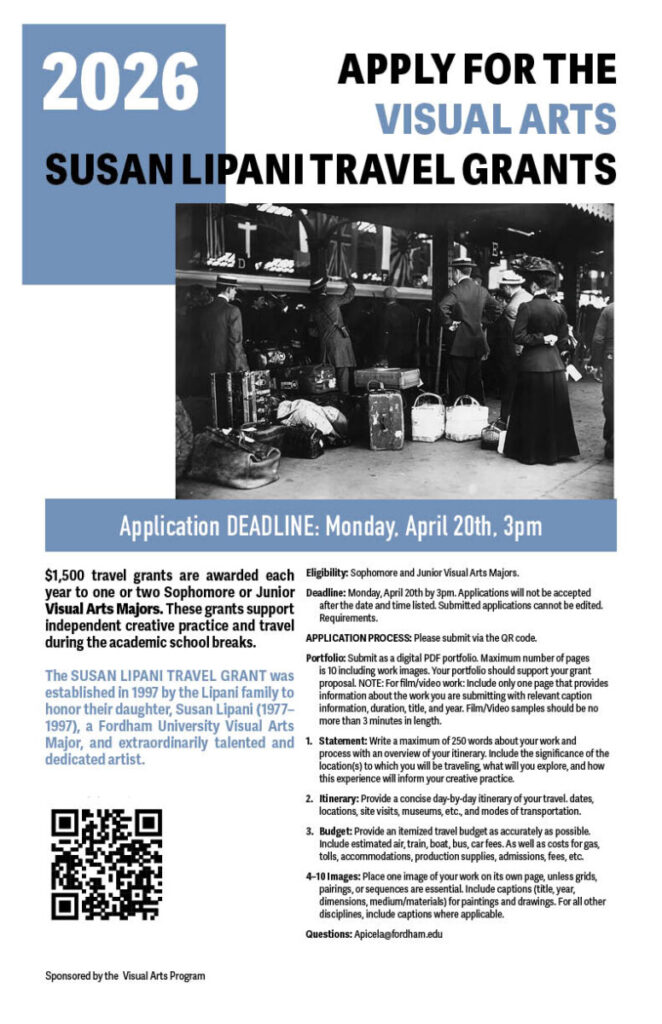
The Susan Lipani Travel Award
Dear photography lovers and patrons of the arts,
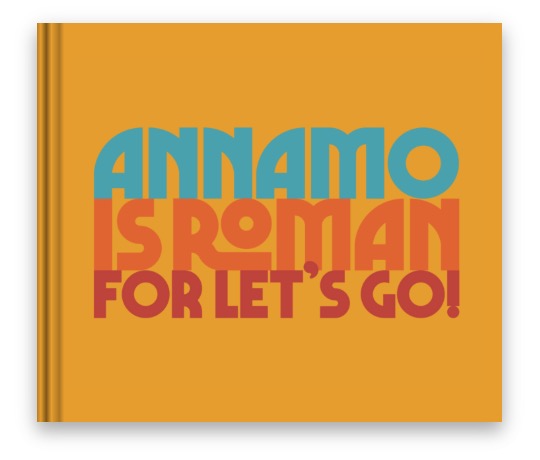
I am proud to announce the release of the 2025 Summer Session One Documentary Photography: Italy class book. At 150 pages, Annamo is Roman for Let’s Go!, is a pleasure to behold. The volume is rich in variety and sharp in perception, thanks to the class participants’ clever brains, quick wits, and indefatigable feet. Also, all those espressi certainly helped.
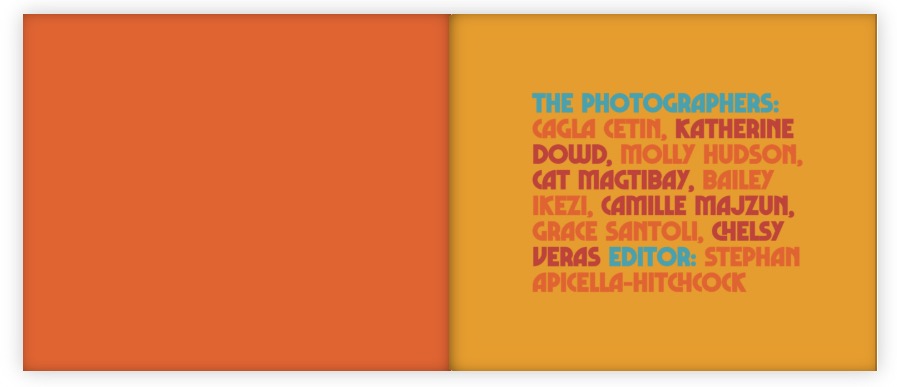
Çağla, Katherine, Molly, Cat, Bailey, Camille, Grace, and Chelsy—Rome may seem like a beautiful and distant dream at this point in the fall; however, by the time you are several pages into your book, you will undoubtedly hear the clanging of church bells and clinking of espresso cups, smell the glorious truffle pasta (that’s Orvieto, actually), and be transported back to our beloved Eternal City of summer 2025. The phrase “Experiential Learning” frequently pops up in academia, but now it probably makes much more sense after all that glorious gelato.
Your over-caffeinated-image-obsessed guide, Stephano Apicella, would like to invite you to the book release party on Thursday, October 30th, 5 pm in Keating 1st (just before the screening of The Exorcist at 6 pm). Come see your images on the big screen, billboard-sized, and enjoy all your smart & hard work. In the meantime, if you can’t wait, you can preview your entire book here. Enjoy!
Grazie mille!


 Stephano
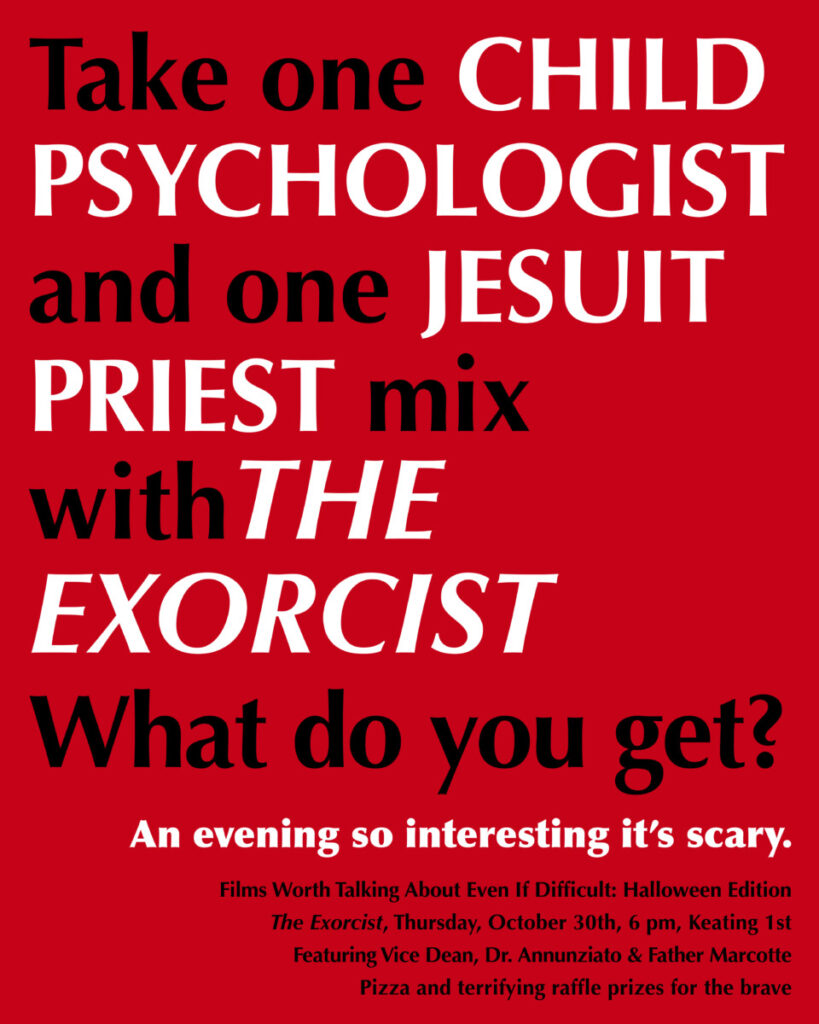
The Office of the Arts & Sciences Dean and the Visual Arts Program present:
Films Worth Talking About, Even If Difficult: Halloween Edition: The Exorcist
The Exorcist
Directed in 1973 by William Friedkin, based on the 1971 novel by William Peter Blatty.
Thursday, October 30th, 6 pm, Rose Hill Keating 1st. All are welcome, so invite your friends. Pizza will be served on the early side.
Featuring:
Dr. Rachel Annunziato, Professor of Psychology, Vice Dean for Arts & Sciences; Father David Marcotte, S.J., Associate Professor of Psychology. Stephan Apicella-Hitchcock, Clinical Professor, Head of the Visual Arts Program, Dean Fellow, will moderate if things heat up. Two randomly chosen lucky winners will take home a terrifying prize.
About the film:
The Exorcist is a horror film released in 1973, directed by William Friedkin and written by William Peter Blatty, who adapted the screenplay from his 1971 novel of the same name. The story chronicles a single mother’s struggle to save her daughter from a mysterious ailment later revealed to be…
Spoiler alert—read no further!
…demonic possession. She enlists the help of two Roman Catholic priests, who attempt to perform an exorcism. The Exorcist was a massive commercial success, bringing in $428 million in its box-office run. It also earned 10 Academy Award nominations, including for best picture and director (the film would win two Oscars, for sound design and adapted screenplay). The Exorcist is a stylistic landmark for the supernatural horror genre and widely considered one of the greatest—and most unsettling—horror movies ever made.
Beyond the highly viceral and disturbing nature of the film, it is also a story about the challenges of modern medicine, the power of faith, doubt, sacrifice, redemption, love, and—of course, it is also about adult anxiety regarding teenage sexuality, loss of identity, motherhood, and the disintegration of the American family—you know, scary stuff—oh, and pea soup (you will know what I mean later).About the series:
For the Films Worth Talking About, Even If Difficult film series, we ask professors, administrators, and staff from across the university to present significant films to the Fordham community that might be unfamiliar or challenging. At screenings, we enjoy pizza together, watch a film, and then discuss it afterward.
As the series title suggests, the films selected, both old and new, are not always easy to digest or understand, and would benefit from thoughtful unpacking by people familiar with the film’s content. Our guest leaders guide attendees in exploring the film’s themes, characters, context, social impact, and stylistic choices. Ultimately, this is a communal exercise where we discuss, discover, and disagree sometimes—which is all part of the experience.
The Office of the Arts & Sciences Dean invites you to step outside your regular streaming queue, experience something different, and join a community of curious cinephiles throughout the year. Please bring your friends, an open mind, and be ready with a question. Additionally, to sweeten the deal, we offer raffle items connected to the film. You could walk away with a special prize AND a different point of view.
Up Next:
Coming in November is Mati Diop’s film, Dahomey, with special guests Associate Professor of African & African American Studies Professor Laurie Lambert and Associate Professor of Art History Maria Ruvoldt.
Previously:
Akira, directed in 1988 by Katsuhiro Otomo, and based on his 1982 manga Akira.
Sponsored by the FitzSimons Civics and Civility Initiative in collaboration with the Office of the Arts & Sciences Dean and the Visual Arts Program
Faculty panelists: Nushelle de Silva, Assistant Professor of Art History; Terrence Mosley, Adjunct Professor, Theatre Program; Anthony A. Berry, FitzSimons Fellow; and Stephan Apicella-Hitchcock, Clinical Professor, Head of the Visual Arts Program
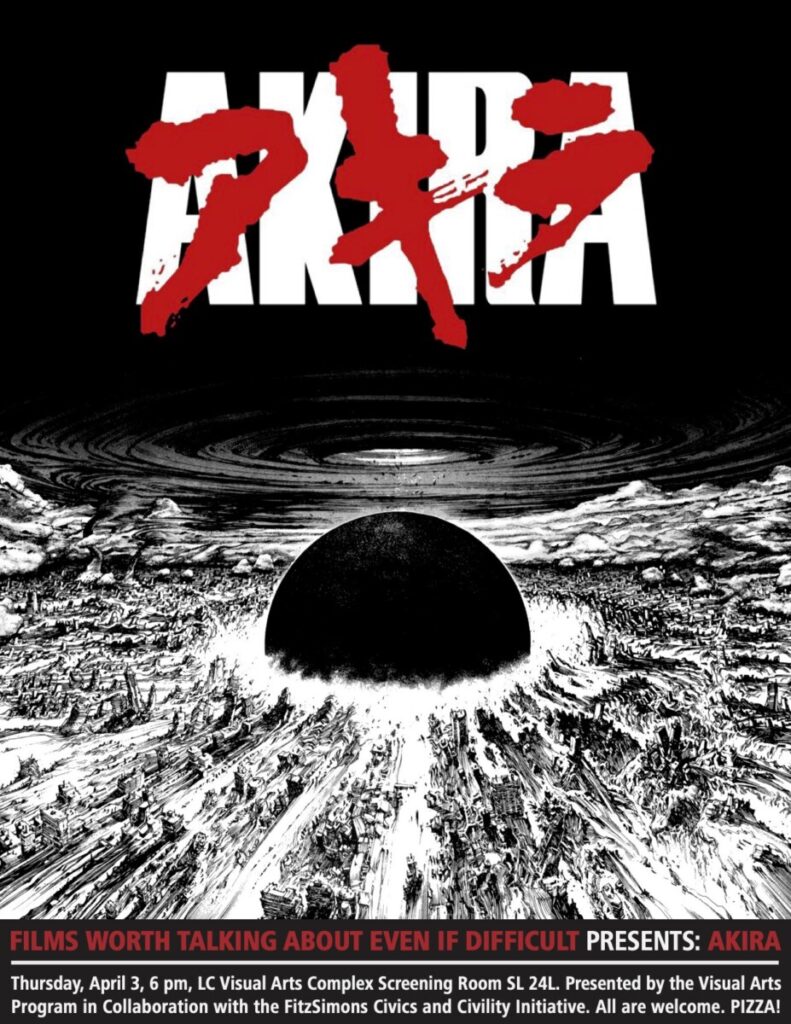
The FitzSimons Civics and Civility Initiative presents: Films Worth Talking About Even If Difficult: Akira. Directed in 1988 by Katsuhiro Otomo, based on his 1982 manga Akira.
Thursday, April 3, 6 pm, LC Visual Arts Complex Screening Room SL 24L. All are welcome. Pizza!Sponsored by the FitzSimons Civics and Civility Initiative in collaboration with the Visual Arts Program
Faculty panelists: Nushelle de Silva, Assistant Professor of Art History; Terrence Mosley, Adjunct Professor, Theatre Program; Anthony A. Berry, FitzSimons Fellow; Rachel Annunziato, Professor of Psychology, Associate Dean for Strategic Initiatives; and Stephan Apicella-Hitchcock, Clinical Professor, Head of the Visual Arts Program
One randomly chosen lucky winner will take home Volume 1 of Otomo’s AKIRA manga.
The following faculty will lead an open discussion about the film with attendees:
Nushelle de Silva, Assistant Professor of Art History. A historian of the built environment; her research is broadly concerned with the relationships between architecture and mobility from the mid-nineteenth century to the present.Terrence Mosley, Adjunct Professor, Theatre Program.
Terrence I. Mosley is a narrative-based director, writer, and performer. He is committed to exploring how collective and personal traumas shape our world. Through that exploration, he aims to build healthier, more equitable social systems.
Anthony A. Berry, FitzSimons Fellow. In this role, he helps coordinate events, programs, and other opportunities across Fordham’s various campuses, engaging the community in how to approach difficult topics with civility and how to engage the different levers of democracy.
Rachel Annunziato, Professor of Psychology, Associate Dean for Strategic Initiatives, Fordham College at Rose Hill, upcoming Vice Dean for Undergraduate Education. Dr. Annuziato is concerned with the transition to adulthood for medically ill adolescents/young adults, healthcare care management in adolescents with a medical illness, and Interactions between medical and psychiatric symptoms.
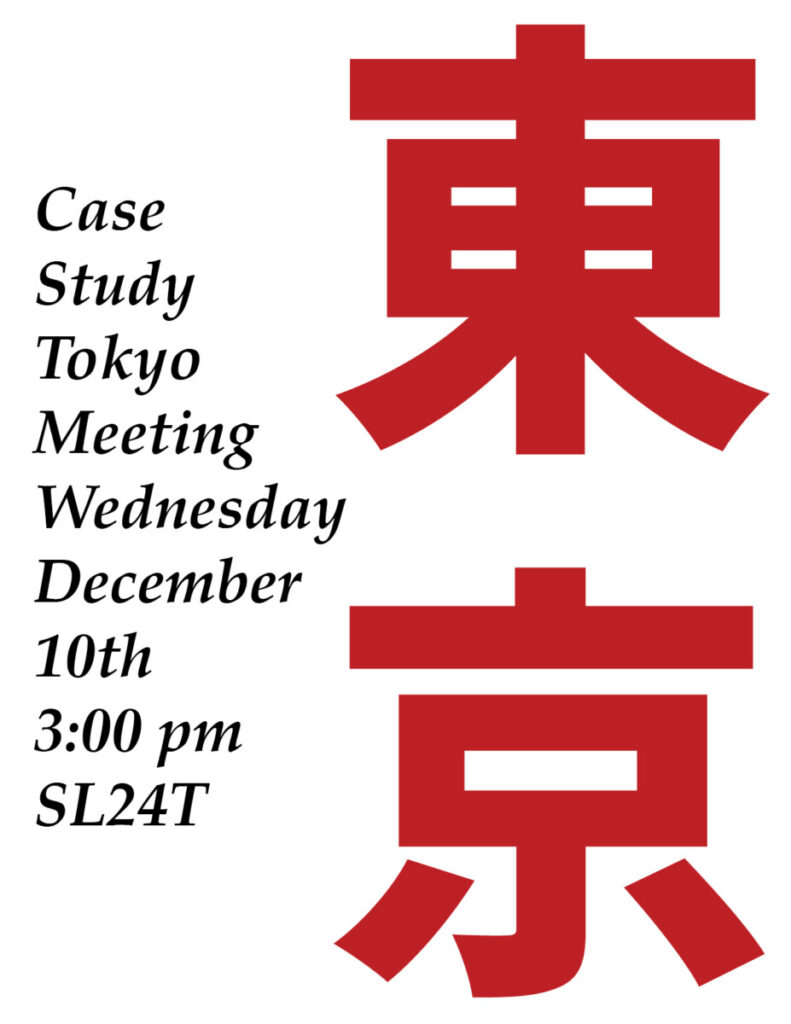
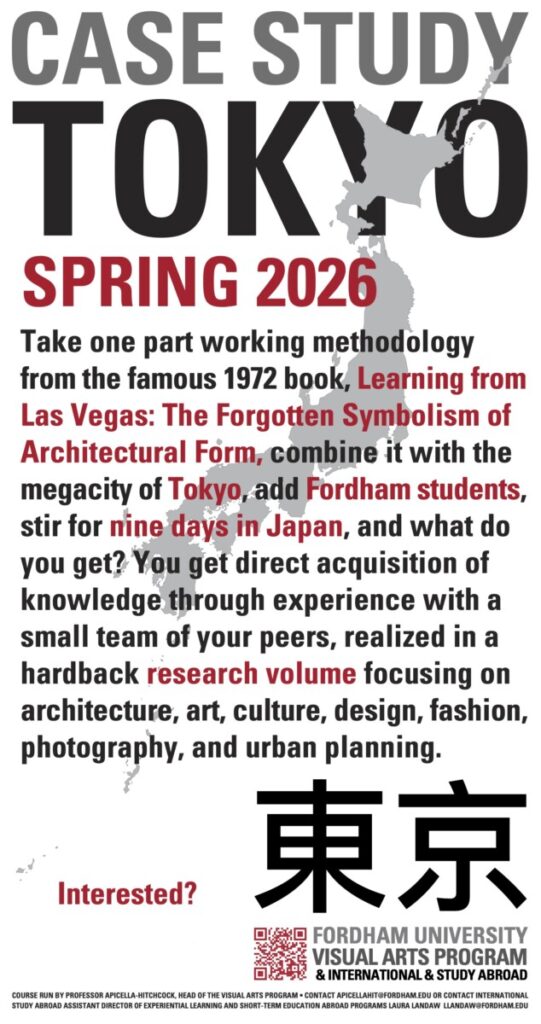
Stephan Apicella-Hitchcock, Clinical Professor, Head of the Visual Arts Program. He leads a study abroad course in Tokyo and is a bit of an Akira nerd.
Considered the most influential feature-length anime film ever made, groundbreaking in the cyberpunk genre, Akira has had an extraordinary impact on popular culture and effectively advanced anime and Japanese popular culture worldwide. The film unflinchingly takes on challenging topics, and societal messages abound pertaining to nuclear holocaust, political corruption, social unrest, the dangers of unchecked power, and the misuse of technology, as well as themes of individuals exploring identity, power, friendship, and the effects of their decisions. Akira powerfully demonstrated the potential of animation to address complicated and mature themes and became a cultural phenomenon, inspiring countless films and anime for almost four decades after its release.
Synopsis: “In 1988, the Japanese government dropped an atomic bomb on Tokyo after ESP experiments on children went awry. In 2019, 31 years after nuking the city, Kaneda, a bike gang leader, tries to save his friend Tetsuo from a secret government project. He battles against anti-government activists, greedy politicians, irresponsible scientists, and a powerful military leader until Tetsuo’s supernatural power suddenly manifests. A final battle is fought in the Tokyo Olympiad, exposing the experiment’s secrets.” —Rotten Tomatoes (91% rating).