Author: Vincent Stracquadanio

CARCELÉN, an exhibition by Joèl De Andrade Ledesma ?>

CARCELÉN, an exhibition by Joèl De Andrade Ledesma

CARCELÉN

Exhibition by Joèl De Andrade Ledesma


Fordham University’s Lipani Gallery
January 19 — February 9, 2024
Opening Reception: January 25th, 6:00 — 8:00 pm
Fordham University at Lincoln Center map
113 West 60th Street at Columbus Avenue
New York, NY 10023
Map to the Lipani Gallery
fordhamuniversitygalleries


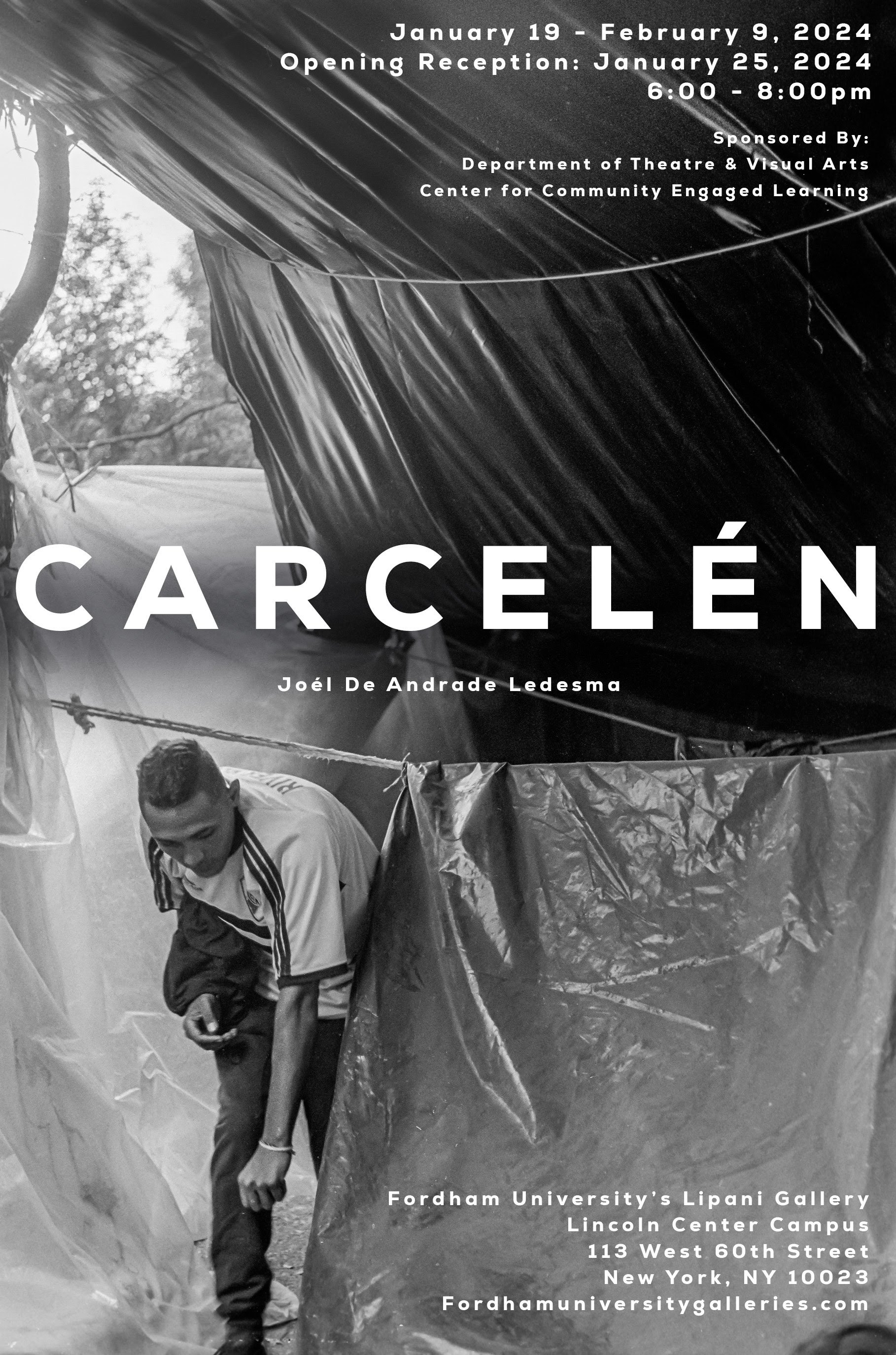
The photographs in Carcelén were taken in 2018 in Quito, Ecuador at a makeshift refugee camp created and inhabited by Venezuelan migrants. This photographic project represents an investigation into the humanity of people, the reality of migration, and the vitality of those who choose to leave their homelands.

Many of the migrants pictured in this project had left home on foot as part of a wave of millions of Venezuelans who left the country in the 2010’s due to political and economic instability. In Ecuador, like other receiving countries, many of the Venezuelans encountered the challenges of xenophobia, accessing basic needs, and attacks by conservative and even fascist elements in society. Joél came in contact with the people of the camps, supporting a mutual aid network that was aware of the plight of these Venezuelans, including attempts by state and local actors to displace them from their camp. In the time spent with the community, Joél exchanged similar and divergent stories of homeland, diaspora, and the reality of migration today.

Carcelén consists of eighteen 13 x 19 prints, matted and framed. The photographs were created from black and white 35 mm film negatives shot on a Pentax K1000, developed in the dark room, and then scanned and digitally printed.

Artist Biography: Joél Alexander De Andrade Ledesma (b. 1989) is a cultural worker, educator, and community organizer. Born in Caracas, Venezuela in the midst of the Caracazo insurrection, Joél and his family migrated to the United States in the wake of this historical and violent event. Having lived as an undocumented immigrant for almost two decades, Joél now focuses his creative, political, and academic projects on making sense of the structural and institutional violence marginalized communities move through. From this perspective, Joél elaborates the ways communities exercise reciprocity, resistance, and resilience. Joél is interested in visual storytelling that demonstrates these qualities and the way people and communities assume the responsibility and reality of freedom, solidarity, and survival


Link to the exhibition

For more information, contact Vincent Stracquadanio
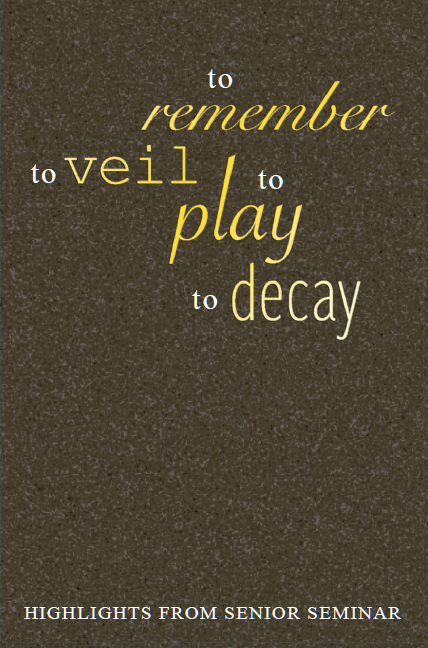

To Remember to Veil to Play to Decay – Selections from the 2023 Senior Seminar ?>

To Remember to Veil to Play to Decay – Selections from the 2023 Senior Seminar

Featuring: Cat Applebaum, Spencer Balter, Julia Boberg, Sara Lockett, Arina Medvedeva, Madison Nash, Erin Newtown, Booch O’Connell, Caroline Wong


The Fordham University Galleries
December 6, 2023 – February 7, 2024
Fordham University at Lincoln Center map
113 West 60th Street at Columbus Avenue
New York, NY 10023
fordhamuniversitygalleries


Every fall, Visual Arts majors persuing their thesis projects work together in the Senior Seminar course to discuss and develop their work – and to support one another in realizing a solo or two-person exhibition in the spring. This show presents a selection of the works produced, to date, by those students.

The poetic exhibition title was conceived of by the students. It reflects both the overlap and the differences in their projects, which come together to touch on themes of loss, chance, movement, memory, the unspoken, trauma, obfuscation, and, as one student wrote in her statement, “the loud and incessant beauty of living.”

 “the loud and incessant beauty of living” comes from the statement of Booch O’Connell


Link to the exhibition
For more information, please contact Vincent Stracquadanio

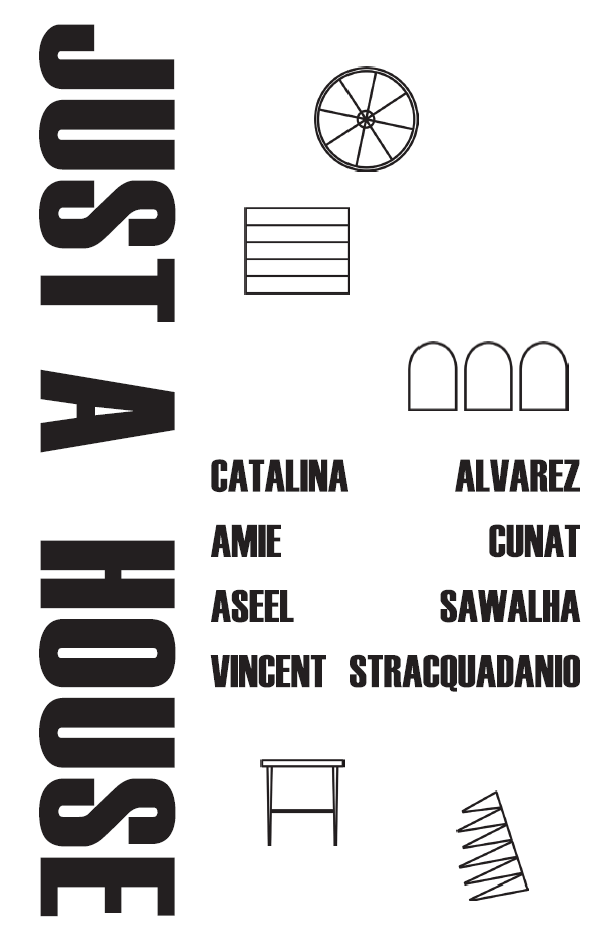
JUST A HOUSE:2023 Faculty Spotlight ?>

JUST A HOUSE:2023 Faculty Spotlight


Featuring: Catalina Alvarez, Amie Cunat, Aseel Sawalha, Vincent Stracquadanio

Reception December 1st – 6:00pm to 8:00pm


The Fordham University Galleries
Fordham University at Lincoln Center map
113 West 60th Street at Columbus Avenue
New York, NY 10023
fordhamuniversitygalleries


Fordham University and the Visual Arts Department is pleased to present Just a House, a group exhibition featuring the work of four faculty members. 

How do we form feelings of beloning? Are there boundaries that describe the contour of these notions? What histories are they made from? Just a House explores ideas of displacement, familiarity, comfort, and connection through sculptural installation. Each artist uses a domestic material or motif, along with an element of suspension from the gallery’s ceiling to prompt conversation about the complicated, sometimes precarious nature of belonging. 


Within Catalina Alvarez’s intimate installation, a grouping of two birch stools (by Peter Blasser), a wooden table (by Daniel Fishkin), a rocking chair, and animal skins invite a visitor to watch two chapters from her anthology film, Sound Spring (Seq. #5 & #7), projected onto a centralized plinth. Unfolding in a series of eight vignettes, Sound Spring explores the history of Yellow Springs, Ohio over hundreds of years, as narrated by its residents in comical scenes: one interviewee rollerblades and reads the village’s water meters, another stands on his head in a breakdancing freeze. The villagers describe American history—their ancestors’ settlements after slavery, a friendship with Coretta Scott King, and Ohio’s Trail of Tears— among other more personal details of village life. By interacting with their own previously recorded media, villagers uncover layers of time and storytelling. 

In Days I’ve Spent, Times I’ve Tried, Vincent Stracquadanio paints sequential rows of Coliseum-like archways on a bed sheet to describe a liminal space between structured architecture and soft installation; between positive and negative space; between conscious and dream worlds. With imagery that draws from Sicilian folkloric traditions, Etruscan frescoes, and Giallo horror films, Stracquadanio frequently uses patterns, gestural abstraction, or archetypical forms to flatten or expand space. The artist generates a purposeful lack of solidity and definition –as if ghostly forms are departing and floating through a dreamlike miasma—offering expressions of grief and longing.


Central points of tension acknowledge and defy the gravity of Aseel Sawalha’s objects. Lantern contains a multitude of hand-folded, paper shapes, which are connected by a system of crocheted netting that cascades from the gallery’s ceiling. The organic entanglement of the vermillion thread contradicts the sharpness of the geometric elements it binds. Passages and Spooler are made of reformations of discarded Fordham books and other found objects (Christmas tree stand, discarded mail tubes).The artist’s work is informed by ethnographic fieldwork research with Bedouin tribes, post-war Beirut, New York City women artists and the art scene in Jordan and Palestine. Meticulously constructed, the sculptures are hybrid restructurings of found books and print matter modified by hand rolling and quilling, weaving, and paint, which mesh forms from modern and post-modern visual arts with techniques from traditional Arabic and Palestinian handicrafts.


Made from paper materials and paint, Amie Cunat’s structure –with ubiquitous siding on its façade and a hunter green interior—resembles an excerpt from a Midwestern ranch-style home. Assumptions about its locale and reference are complicated by its construction. Influenced by unnamable sentience within horror movies like the The Blob, The Thing, and Them! and false front architecture, Cunat’s object contains two Crappie gills that disrupt the logical continuity of its domestic container. Window and Gills, Tatami Tan is both alien and familiar; animal and built.


Link to the exhibition
For more information, please contact Vincent Stracquadanio

For the Visual Arts Department Blog: click here.
For the Visual Arts Department Website: click here.

Fifteen, Sixteen Foxes – Paintings by Dan Fig ?>

Fifteen, Sixteen Foxes – Paintings by Dan Fig

Fifteen, Sixteen Foxes

Paintings by Dan Fig

Reception December 1st – 6:00pm to 8:00pm


The Fordham University Galleries
Fordham University at Lincoln Center map
113 West 60th Street at Columbus Avenue
New York, NY 10023
fordhamuniversitygalleries


Dan Fig, not so much the pessimist as the anxious doubter, stares the Gorgon in the face: if our consciousness is being molded by GUIs (graphical user interfaces), he proposes, wide-eyed, to let into the same space a whole host of different realities.  The result is an orbit without anchor point, a web of relativity, a sui generis game of self-cancelling logic.  Play is a method here as well: a way of channeling the energy (terror) of life in times of clip-art overload, but without faith that any revelation will ensue.  From a surfeit of pictures, a tight grid emerges.  

The paintings endure this tightening stoically.  It’s worth noting that for the Stoics, the goal of indifference was freedom.

-Text by Gaby Wolodarski


Link to the exhibition
For more information, please contact Vincent Stracquadanio

For the Visual Arts Department Blog: click here.
For the Visual Arts Department Website: click here.

Chile/Dignidad: 1973-2023 ?>

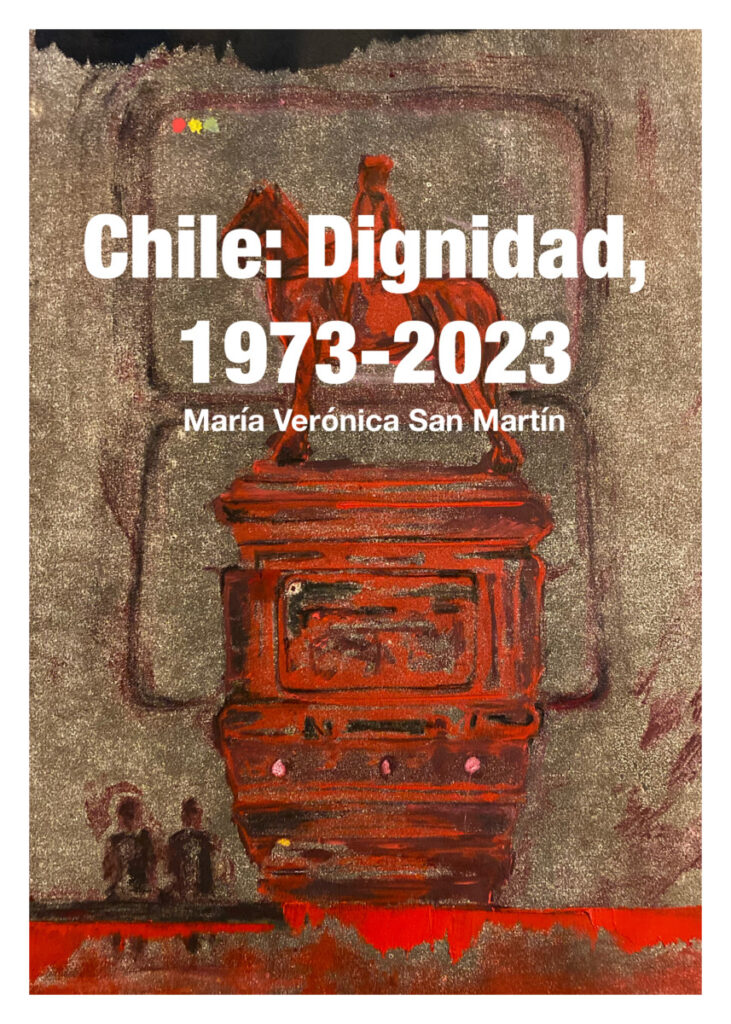
Chile/Dignidad: 1973-2023

Art exhibition by María Verónica San Martín

Fordham University’s Lipani Gallery
August 21—October 4, 2023
Performance by the artist and public reception: September 7th, 5:30—7:30 pm
Fordham University at Lincoln Center map
113 West 60th Street at Columbus Avenue
New York, NY 10023
Map to the Lipani Gallery
fordhamuniversitygalleries


Chilean-born, New York-based artist María Verónica San Martín offers a retelling through performance, book art, and engravings of politically crucial moments of recent Chilean history and their interconnectedness with US experience. As we approach the 50th anniversary of the coup d’état against Chile’s democratically elected socialist president Salvador Allende, this exhibition focuses on San Martín’s motif of Dignidad as a connector of different elements of Chilean and US history across time and space, denouncing past abuses and crying out for social justice.

These elements include the coup on September 11, 1973—actively supported by the CIA—as well as other events before and afterward. One is the establishment in 1961 of Colonia Dignidad, an autarchic, fascist compound in southern Chile that aided in the torture and repression of leftist dissidents throughout the seventies and eighties. Meanwhile, in a finely made series of artist’s books, San Martín calls out for the dignity of the people tortured and disappeared by the dictatorship. The exhibit finishes with San Martín’s more recent etchings representing Chile’s social upheaval in 2019, in which protesters against neoliberal scarcity, state-sponsored racism, and police violence rechristened one of Santiago’s central squares as Plaza Dignidad. 

The multidisciplinary exhibit—San Martín’s third solo exhibit in New York City—comprises eighteen pieces, including one sculpture, four artist’s books, two video screens showing a series of performances by the artist, and eleven engravings. The pieces are organized chronologically to trace the development of the concept of “Dignidad” over the past sixty years in Chile. There is a series of explanatory texts that contextualize the works within Chile’s history and culture.

These activities will provide an opportunity for three different academic departments at Fordham – Modern Languages and Literatures, Communication and Media Studies, and Visual Arts – to collaborate in an effort to position art, cinema, and literature as ways of working through the trauma of the coup and keeping the memory of the dictatorship’s victims alive.
 

At the opening reception on September 7, San Martín will introduce her work and do a mini-performance.

The exhibit is part of Chile 1973/2023, a series of programs organized by Fordham, Columbia, Princeton, and New York Universities to commemorate the 50th anniversary of Chile’s military coup through art shows, film screenings, and literary events.


About the artist: María Verónica San Martín (b. 1981) is a Chilean, New York-based multidisciplinary artist and educator who explores the impacts of history, memory, and trauma through archives, artist books, installation, sculpture, and performance. She was a fellow at the Whitney Museum’s Independent Study Program and holds an MA from The Corcoran School of Art and Design, George Washington University, Washington DC. She has exhibited nationally and internationally at BRIC Arts Media, Brooklyn, NY; Artists Space, the New York Immigrant Artist Biennial, the Queens Museum and Rockefeller Center, all in New York City; at Trinity College, in CT; at the Print Center in Philadelphia, PA; and at the Chilean National Archive, Galería NAC, and Galería Animal in Santiago and at the Museum Meermanno, The Hague, Netherlands. Her work is held in more than 60 collections, including the Metropolitan Museum of Art, New York; the Walker Art Center, Minneapolis, MN; the Watkinson Library, CT; the Museum of Memory and Human Rights, Santiago, Chile; and the Centre Pompidou, Paris, France. María is currently working on a commission for NMWA’s Holding Ground: Artists’ Books for the National Museum of Women in the Arts project while preparing her first solo exhibition in Canada at The Goethe-Institute in October. She teaches at Parsons, The New School, NY; the Center for Book Arts, NY; Penland School of Craft, NC; The University of Miami, OH, and is part of the education program of Booklyn Art as well as an artist and board member.

Exhibition curated by Carl Fischer, Professor and Chair, Department of Modern Languages and Literatures, Fordham University


Link to the exhibition

For more information contact Carl Fischer: carl@fordham.edu, 718 817 2632

For more information about the artist: www.mveronicasanmartin.com 

For more information about Chile 1973/2023www.chile2023.art