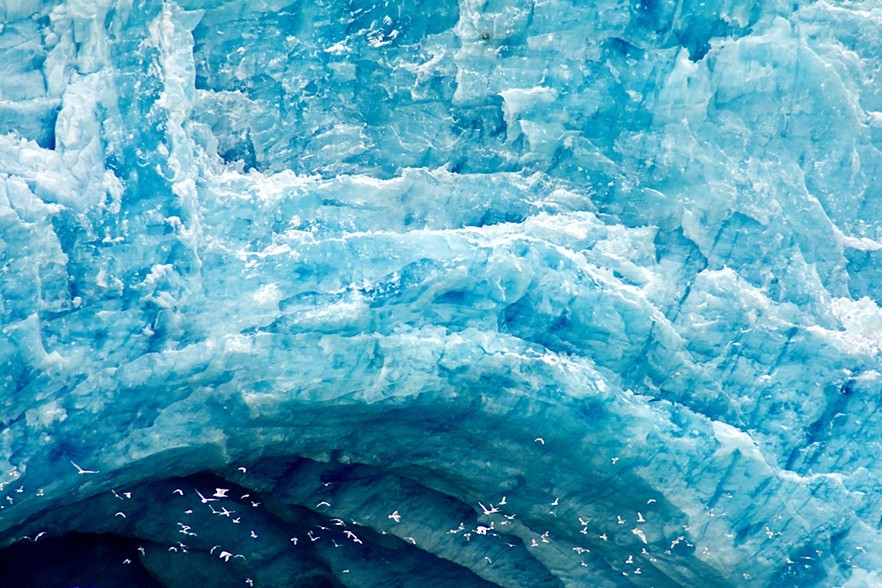
The Arctic Circle: SMEERENBERG GLACIER, CALVING
A short film by Adam Laity
The Ildiko Butler Gallery
February 25 – March 3, 2018, Gallery Talk with Carleen Sheehan: Tuesday, February 27, 6pm
‘Instead of the sudden apocalypse brought about by Vesuvius, our future fossils layers are piling up slowly but steadily as an emblem of an apocalypse in slow motion.’ – Jussi Parikka, A Geology of Media
This sequence is part of a larger cinematography project exploring how the ecosublime landscape is at the heart of how we, the human frame ourselves within the Anthropocene.
It was filmed at a latitude of nearly 80° North on the Norwegian archipelago of Svalbard in June of 2017, where I was one of 30 artists and scientists on a residency aboard the sailing ship Antigua.
The full film will be framed by a spoken essay poem- for this space we decided to screen just the images, sounds and the score. The intention behind this decision is to enable the viewer to focus on the experience of watching the calving, as if it were a poem or a meditation.
We have included Nick Drake’s poem The Ice Core Sample, with the kind permission of the writer, as it speaks to many things that we felt, experienced and talked about on our journey in the High Arctic. I appreciate how the words give a focus and context to the images- in the same way I hope that the images add colour and shape to the ideas that the words evoke.
We live in a visual age- we learn and receive information by, create narratives in and express ourselves through pictures. Every image, whether it is reportage, documentation, montage, propaganda, graffiti, artist video or cinema motion pictures represents a specific and considered view of the world that suggests a persons ‘truth’ or perspective of how they see themselves and the world around them.
And in this visual age, the proliferation of ‘the selfie’ as an act of identification, witness and as a means of expression, demonstrates a very specific and clear idea- that of we the human putting ourselves at the centre of everything.
The first time I visited New York I went to MoMA and tried to view Van Gogh’s Starry Night, but couldn’t get near it for people taking pictures of themselves standing in front of the famous landscape painting. When I visited the Memorial to the Murdered Jews of Europe in Berlin the same phenomenon- tourists climbing all over the concrete slabs with ‘selfie-sticks’ and 360° cameras – “Look at me being in the world!!”
In my research I suggest that the ecosublime landscape is the antithesis of the selfie- placing we the human directly within and an intrinsic part of the landscape, instead of using it as merely a backdrop or putting ourselves arrogantly before it.
I suggest that the ecosublime landscape is the last of three inter-related categories: the first is landscape, and the second is sublime landscape.
Landscape is concerned with how humans sees the world- how we frame it in ways that we can control it or make sense of it, specifically in ways that aren’t overwhelming. Landscape is often beautiful, for example a pastoral scene or postcard of a sunset.
Sublime landscape stems from philosophy and Romantic poetry, made visual first in painting and then photography and cinema- and specifically depicts the human figure in relation to the power of nature in the landscape. For the Romantics this often depicted man’s terror in and fear of nature- they would undoubtedly have identified this glacier calving as sublime. We witness the power of nature and the relatively insignificant human figures and vessels where humans can do little more than stare at the awesome forces at work within the landscape.
Image: Philip James De Loutherbourg’s An Avalanche in the Alps (1803)
While such a word as sublime is both divisive and wholly subjective, philosophy, poetry, painting, photography and cinema evidence a clear difference between a landscape and a sublime landscape. The latter is fundamentally concerned with the human’s relationship to natural world…. Refer here to elements taken from my subjective manifesto…
But as science and scientific methods develop, and we better understand the natural world and our impact on it, so the sublime itself must be reconceptualised and contemporised.
This need for change is both political and philosophical, and driven in no small part by the iteration of technological tools available to the artist through which to explore and express the sublime, i.e. analogue film to digital cinema- so our relationship to the sublime has been forced to progress and change.
Where the paintings of Friedrich or the photographs of Edward Burtynsky offer a meditation on a sublime landscape moment in time, the dynamic power of cinematography enables me as a cinematographer to move towards, through and beyond a sublime landscape moment. And the movement that cinema provides- movement both physical and temporal- allow the cinematographer and subsequently the viewer to experience the sublime landscape like never before.
The third and most contemporary iteration is, almost by necessity, as ecosublime landscape that is a sublime landscape that is directly tied to ecological disaster and the environmental impacts of anthropogenic climate change. A reference is the work of Edward Burtynsky, where the relationship of human industry and the subsequent damage to the environment is striking.
Image: Edward Burtynsky Sudbury Nickel Tailings #34 (1996)
These three stages are reflected in my own experience of filming the calving sequence, and in my own subjective narrative that I’ve subsequently shaped in editing the work. The first part of my experience is a physical arrival in a location, and my presence as an artist in and witness of landscape. I see, breath and feel in the landscape; my hands and eyes manoeuvre and adjust my camera; my breathe and energy determine what I can capture and for how long; and my camera effectively translates my thoughts and feelings in to digital images and sounds- to put the entire process in very crude terms.
The second part is an acceptance that my own presence and especially the visual presence of other humans within the image render’s the landscape sublime. So too do the shared experience of viewing the glacier calving- the tension of waiting for the moment; the shotgun sound of ice cracking and splintering in the distance; the excitement of the birds who anticipated a new meal scraped up from the fjord bed as the ice churns the water; the adrenaline as the ice falls and everyone whoops and cheers, while I try to remain steady and calm enough to capture the moment; the aftermath and the thrill of the mini tsunami generated by the calving that rocks the Antigua like a fairground ride; the calm and quiet afterwards, followed by the subsequent practical concerns of reviewing the footage to make sure the moment was indeed captured in a way that truly reflects the experience.
The third part of my experience is something that is inherent, but perhaps latent in these images- something nearly impossible to put into words, the suggested existence of an ecosublime landscape moment.
We know that glacier calving is a natural phenomenon- it’s what glaciers do and have always done. Excess snowfall on higher-ground compacts into rivers of slow-moving ice that descend to the ocean where they break into icebergs or varying size. We know that glaciers can store ice for hundreds, even thousands of years.
But what science now tells us is that we, as a species of nearly 8 billion individual organisms, are through our own behaviour changing the very dynamics of nature. Specifically, in this case, we know beyond any rational or reasonable doubt that anthropogenic climate change is increasing the speed of the movement and deterioration of polar glaciers- just like this one.
And we know that as the polar ice caps melt faster each year, and the ice masses move from their homes on land into the ocean, global sea levels will rise and destroy many coastal environments, including towns and cities.
My ecosublime moment was one in which I as a subjective human, and as a cinematographer, standing in front of a calving glacier, realised in that moment that as one of a species of nearly 8 billion individual orgasms I have a direct responsibility to how this glacier behaves.
Within this same moment I experienced a realization that I was so closely connected to the glacier as to be almost one and the same thing. I was at the same time keenly aware of my being in the world and inter-being with the landscape I was looking at. I felt the ice moving before I heard it or saw it fall. I felt the movement in the water through my feet standing amidships on the Antigua as the ice produced waves. I was overcome, as the ice face sheared and cracked, by new shades of blue that I had never seen before. I thought of my children and felt a palpable fear and an impossible sense of hope.
I understood, with alarming force, the idea of Parikka’s apocalypse in slow motion- an apocalypse so creeping and insidious that for decades we’ve been able to fool ourselves into believing that it didn’t exist. We no longer have that luxury.
Reflecting on my experience in the high Arctic, I believe that the role of contemporary artist is to encourage two things in those who view and experience their work. The first is to foster a hope that is reasonable and practical. We must be realistic and accept that the odds are heavily stacked against us- and yet I believe that hope is important. Not the hope of yesterday, of our fore-parents or centuries of religious bigotry; not the hope for the future, that one day things might just come right and that something or someone might save the day; but the hope of the present where each day we try to make a positive difference and strive to live mindfully for the moment with compassion, empathy and love.
The second is to explore the idea that we need to accept responsibility for our being in the world, and make peace with our place in the landscape of the Anthropocene. There will continue to be great beauty and sublime moments in the difficult times ahead- artists must continue to seek them out and paint them, take pictures of them and write songs about them so that others may experience them too.
 Faculty Spotlight 2018