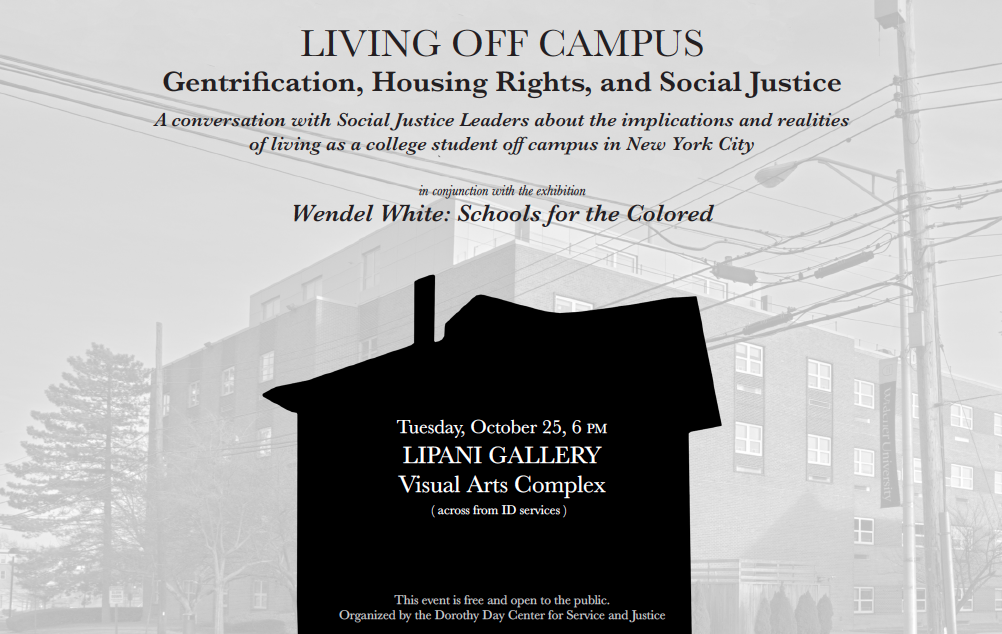
LIVING OFF CAMPUS: Gentrification, Housing Rights, and Social Justice
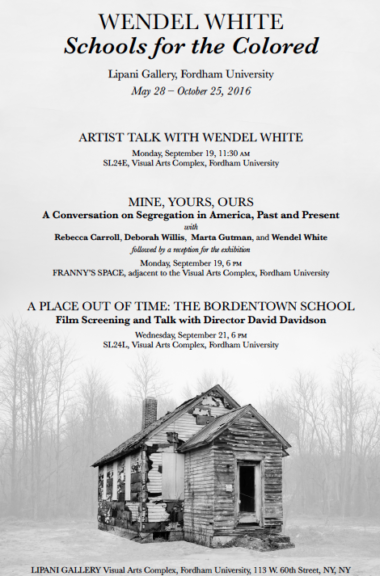
Artist Talk with Wendel White
Monday, September 19, 11:30 am
SL24E, Visual Arts Complex, Fordham University
Mine, Yours, Ours
A Conversation on Segregation in America, Past and Present with
Rebecca Carroll, Deborah Willis, Marta Gutman, and Wendel White
followed by a reception for the exhibition
Monday, September 19, 6 pm
Franny’s Space, adjacent to the Visual Arts Complex, Fordham University
A Place Out of Time: The Bordentown School
Film Screening and Talk with Director David Davidson
Wednesday, September 21, 6 pm
SL24L, Visual Arts Complex, Fordham University
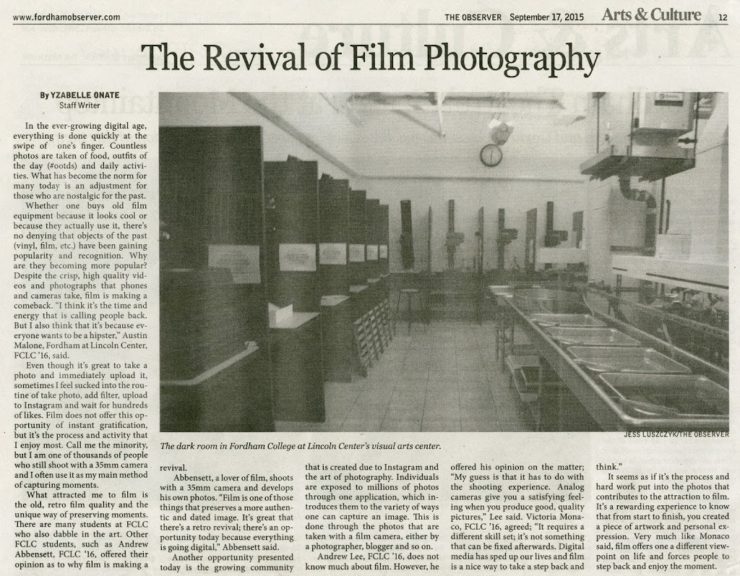
Last Halloween (my birthday, as it happens), I loaded up my Bolex to shoot some 16mm black-and-white images of a children’s costume parade in my Brooklyn neighborhood. I was thinking of Helen Levitt’s 1948 masterpiece, In the Street. Levitt (and her co-cinematographers James Agee and Janis Loeb) used a small camera to surreptitiously record images (mostly of children) in Spanish Harlem. The film is a poetic time capsule — observational vignettes that become more than the sum of their parts.
The Bolex looks pretty big these days compared to digital cameras, so I wasn’t hiding anything from anybody. As I stood on the sidewalk next to parents snapping cell phone photos, I encountered a fair amount of resistance. Several people asked me point blank what I was doing (which I thought was pretty obvious). They seemed unsatisfied with my admittedly vague response (“Shooting some footage, may turn it into a short documentary”).
Read the rest of the article at filmmakermagazine.com
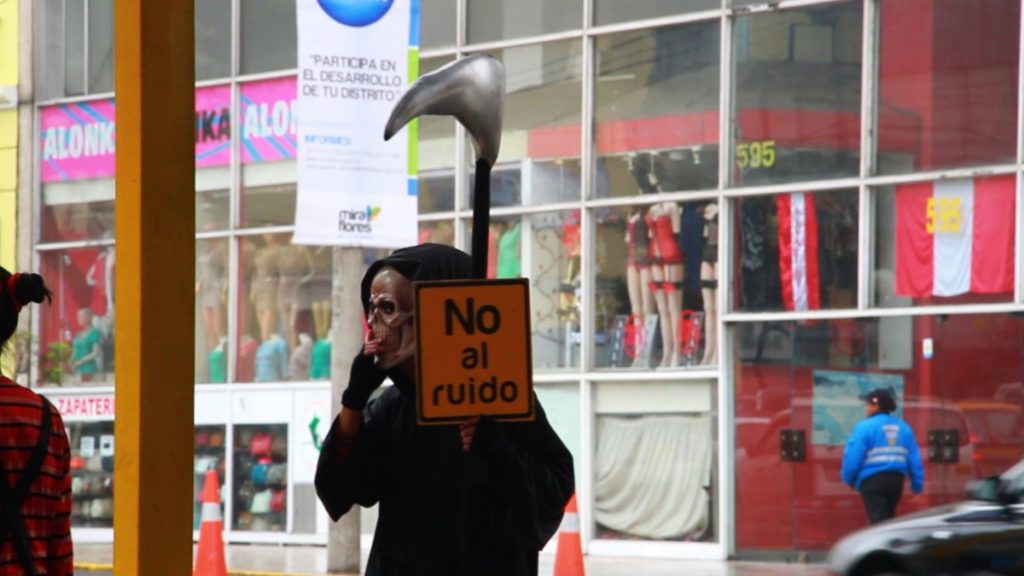
Photo credit: Lima Limpia, 2015, Mark Street.

Please join the Fordham University Friends of Films for Photographers and students from the course Senior Seminar 2015 for a screening of Wong Kar-wai’s 1994 film, Chungking Express.
Food and friends are both welcome.
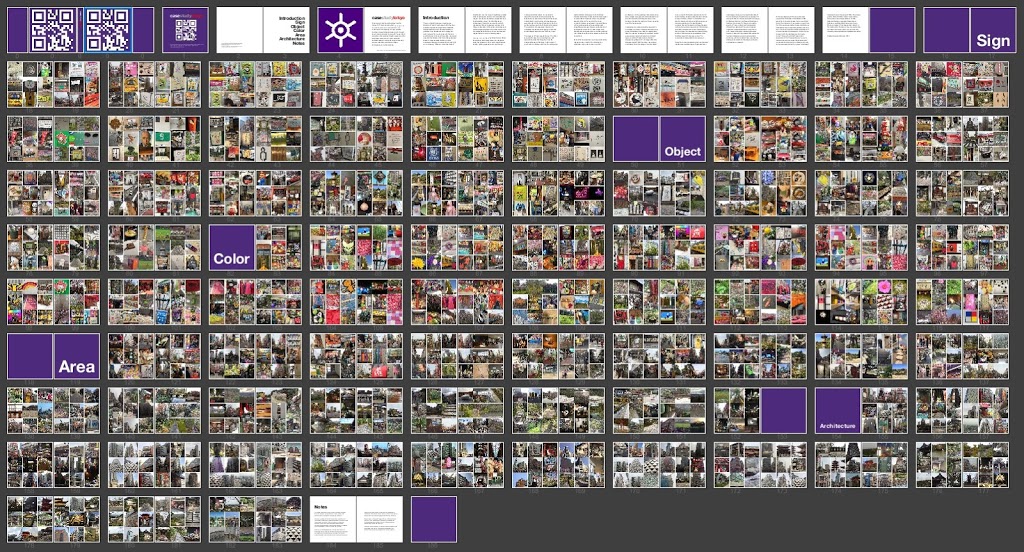
Take one part working methodology from the famous 1972 book, Learning from Las Vegas: The Forgotten Symbolism of Architectural Form, combine with the megacity of Tokyo, add ten Fordham University Gabelli students, stir for nine days in Japan and what do you get? You get direct acquisition of knowledge through experience with a small team, realized in an online, as well as hardback research volume focusing on branding, sensory marketing, architecture, design, photography, and urban planning.
Get set—Case Study: Tokyo: 2016!
The Case Study Tokyo 2014 book in the Fordham University Library.
Marketing and the City: Tokyo course description.
For more information email Professor Apicella-Hitchcock
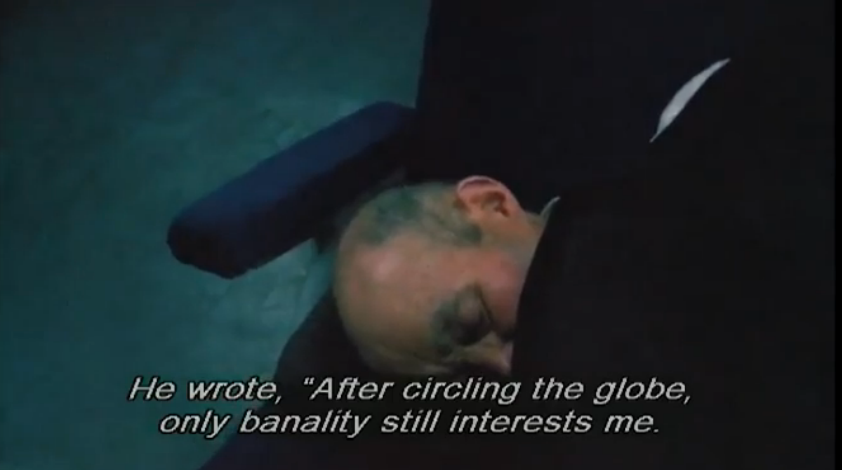
Please join the Fordham University Friends of Films for Photographers and students from the course Documentary Photography: Japan 2015-2016 for a screening of Chris Marker’s 1983 film, Sans Soleil.
Read Chris Marker: Memory’s Apostle By Catherine Lupton
Read the Sans Soleil script
Food and friends are both welcome.
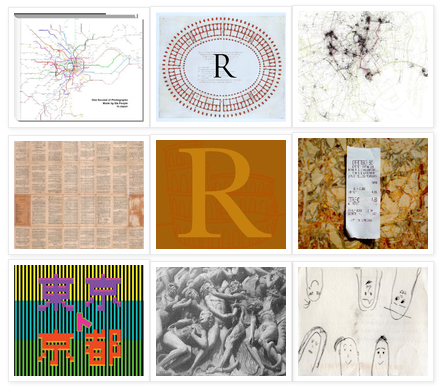
One Second of Photographs Made by Six People in Japan
Documentary Photography: Japan 2014–2015
By Doheny Lilly Stone Umeda Wan Ye
Edited by Stephan Apicella-Hitchcock
Link
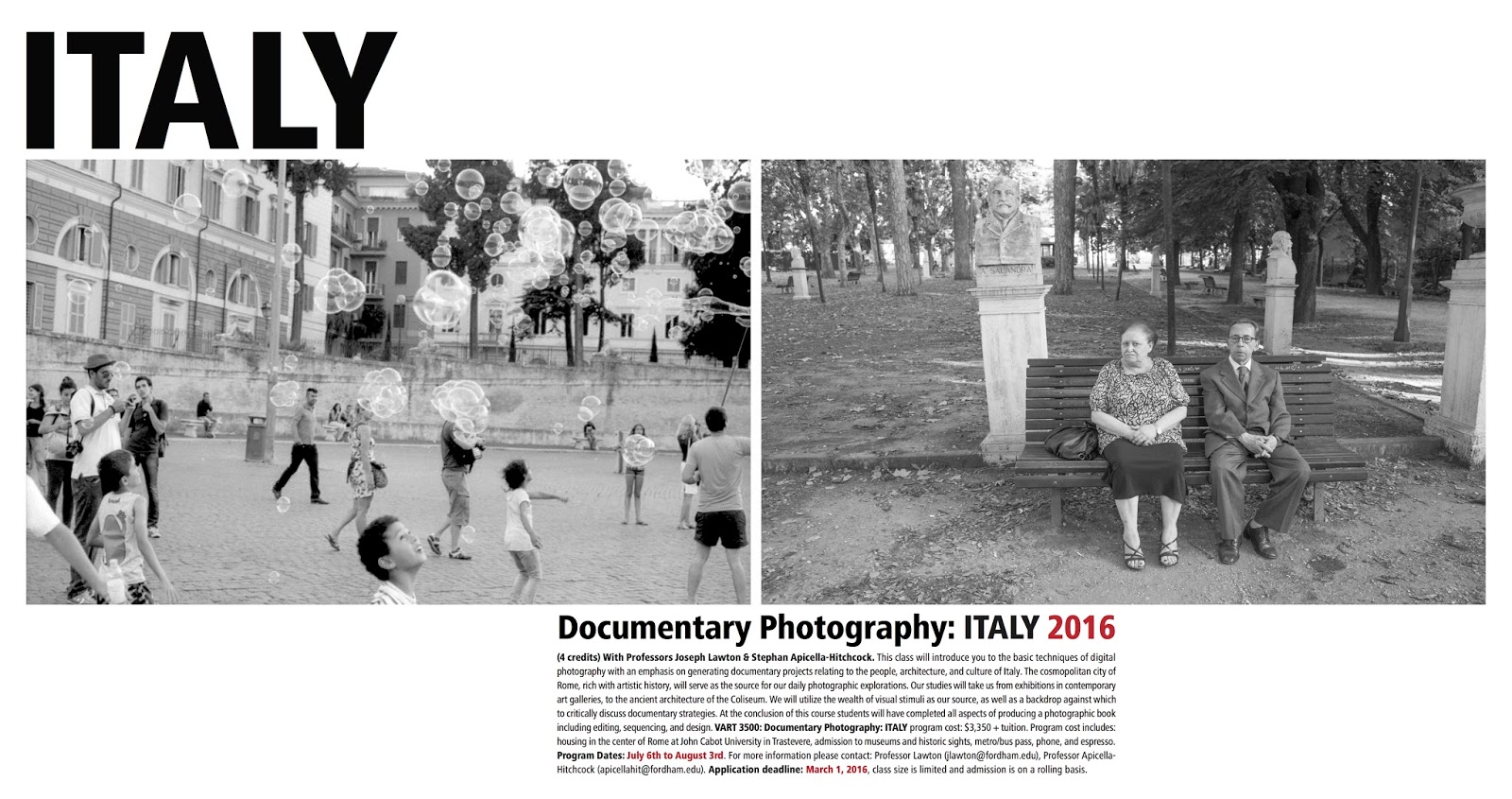
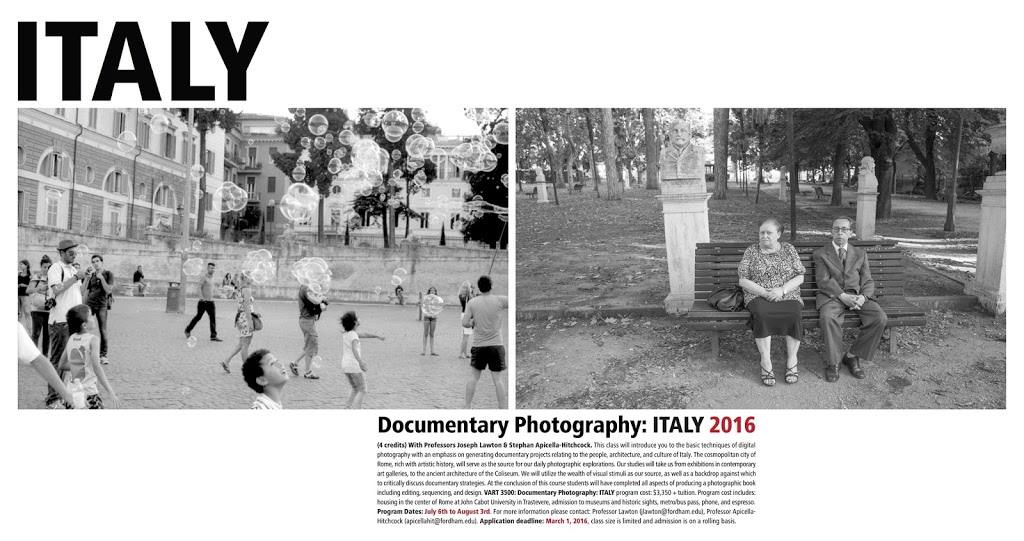
Documentary Photography: Italy 2014
By Basile Cordi De Carion DeBonis DiPane Hellauer Hua Kelly Lazzaro Puntillo Spina Zhu
Edited by Stephan Apicella-Hitchcock & Joseph Lawton III
Link
One Second of Photographs Made by Six People in Japan
Documentary Photography: Japan 2013–2014
By Hua Kirsch Langley Santoro Wilson Zheng
Edited by Stephan Apicella-Hitchcock
Link
Documentary Photography: Italy 2013
By Brown Chang Kalil Nelson Puchinskaya Rusnack
Edited by Stephan Apicella-Hitchcock & Joseph Lawton III
Link
One Second of Photographs Made by Six People in Japan
Documentary Photography: Japan 2012–2013
By Anacker Hemmert Kim Krakowski Mainguy Scherer
Edited by Stephan Apicella-Hitchcock
Link
R (Documentary Photography: Italy 2012)
By Abrahams Aparicio Atwood Garcia Iliesiu Krakowski Longo Mottola Murphy Raganella Tozzi Vollrath Wendroff Zheng
Edited by Stephan Apicella-Hitchcock & Joseph Lawton III
Link
One Second of Photographs Made by Six People in Japan
Documentary Photography: Japan 2011–2012
By Carrizales Chamberlain Iacono Mavrovitis Salinas Zoltowski
Edited by Stephan Apicella-Hitchcock
Link
R (Documentary Photography: Italy 2011)
By Giunta Iacono Jolly Mavrovitis Moreno Zimmerman
Edited by Stephan Apicella-Hitchcock & Joseph Lawton III
Link
One Second of Photographs Made by Six People in Japan
Documentary Photography: Japan 2010–2011
By Colacicco Fiore Greenberg Hartnett Moreno O’Rourke
Edited by Stephan Apicella-Hitchcock
Link
Roma (Documentary Photography: Italy 2010)
By Bozzone Colacicco Cook DeMeo Detjen Krupitsky Peguero-Vidal Smyth Tanksley Vasquez
Edited by Stephan Apicella-Hitchcock & Joseph Lawton III
Link
THE EVIL GENIUS OF A KING
A new project by Matthew Bakkom
Curator: Stephan Apicella-Hitchcock
October 14–December 6, 2015
Reception: Thursday, October 29, 6–8 pm
Fordham University’s Lipani Gallery
113 West 60th Street, New York, NY 10023
fordhamuniversitygalleries.com
The Lipani Gallery is located in the Visual Arts Complex in the street level of the university
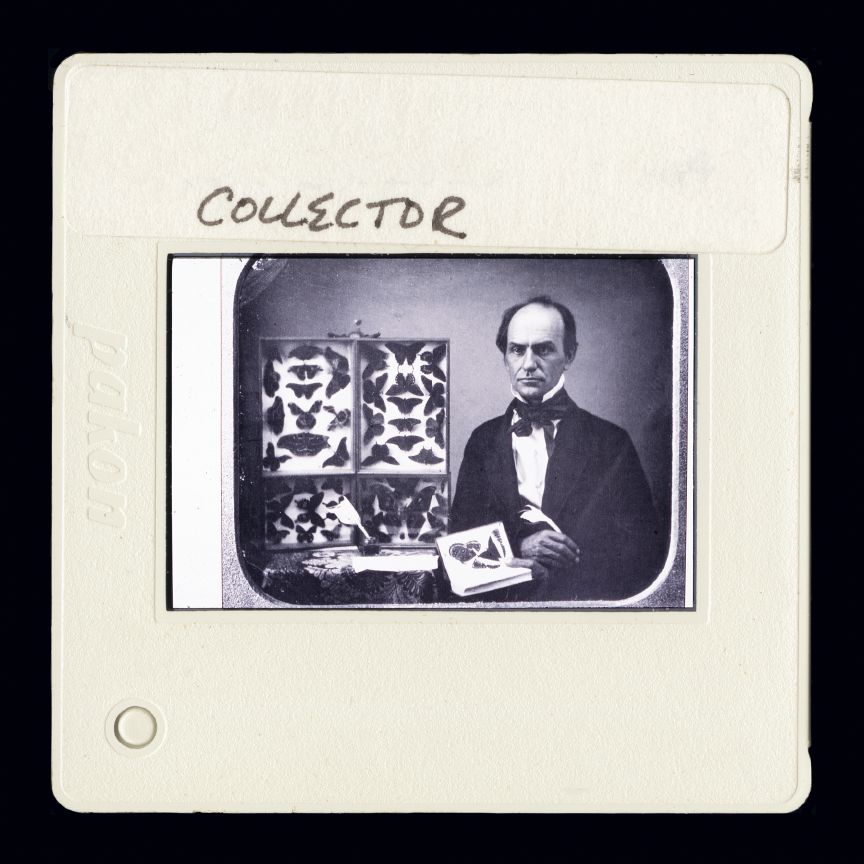
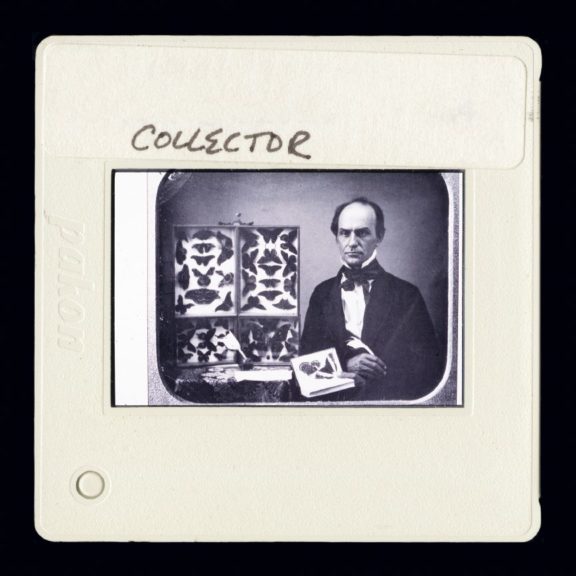
Image caption: Collector, 12.5” x 12.5” mounted Inkjet print, 2013
The Department of Theatre and Visual Arts at Fordham University is pleased to present THE EVIL GENIUS OF A KING, a new project by Matthew Bakkom. This exhibition brings together fifty-two enlargements made from a deaccessioned art and art history slide collection from St. Cloud University in Minnesota.
The artist was given this teaching collection—approximately ten thousand 35mm slides—and utilized the material to generate a survey through the history of art; however, a survey that entirely avoided traditional classification according to eras and movements, rather interpreting the collection based on chance juxtapositions and natural affinities. The 12.5” square images are installed in a continuous band that encircles the Lipani Gallery. Connections arise at times from linguistic puns between caption information on the slide mount, from formal relationships between images, and from associations between image content.
One might consider the sequence of imagery not unlike a plan for a discursive lecture in support of a curious theory. In this respect, Bakkom’s working methodology and objectives are illuminating:
“I proceeded to draw them [the slides] one by one from the large boxes into which they had been cast. The very first that came to hand was an image that inspired the title of the show. From this point of departure I combed through the remainder, sifting and winnowing in the hopes of discovering what exactly the evil genius of a king might be. I invite the audience to join me in this speculation, one that is pieced together through a series of new photographic documents that aspire to grasp and share specific moments of our shared aesthetic and technological past.”
THE EVIL GENIUS OF A KING is a subjective inquiry into the trajectory of art history, as well as homage to a now obsolete teaching technology. The shift from the first image in the exhibition, the boardroom of the Whitney Museum of art, to the second, the Tower of Babel, sets the tone for what is to follow. Across fifty-two slides, art historical notions pertaining to style, influence, and tradition are circumvented, yielding a visual narrative that is alternately critical, poignant, and at times quite humorous.
Stephan Apicella-Hitchcock, 2015
(for more information please email: apicellahit@fordham.edu)
Matthew Bakkom (B.1968) is an Assistant Professor at the University of Wisconsin-Madison. Since the early 1990’s he has been active as an artist and organizer in the U.S. and Europe. His first book, New York City Museum of Complaint was published in 2009 by Steidl-Miles.
(for more information please email: Stephan Apicella-Hitchcock)