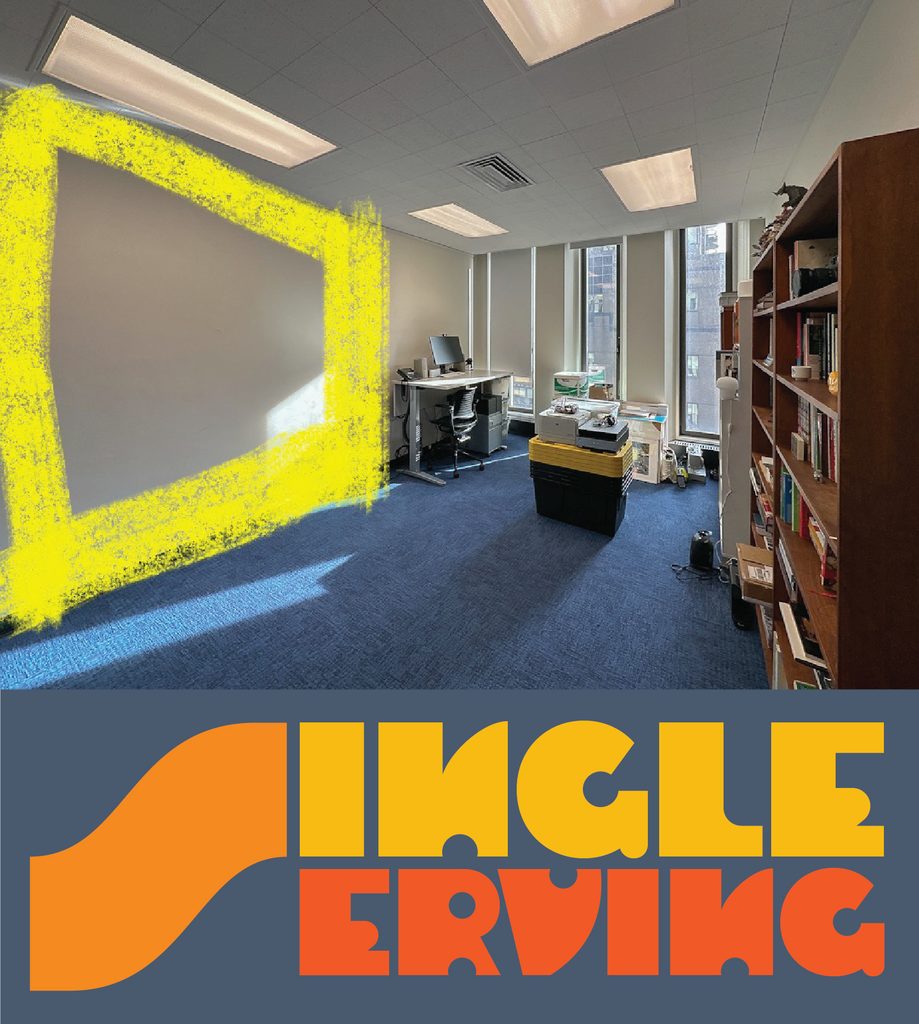
Single Serving is an 8′ x 8′ space that exists solely to showcase one piece of art at a time, for one person at a time.
Located in the Office of the Associate Dean for Undergraduate Education at Fordham University’s Lincoln Center Campus, removed from the world of commerce and the hustle of urban life, this modest endeavor presents the Fordham community and guests with an opportunity to pause, view thought-provoking work, and reflect.
Individuals interested in experiencing art firsthand in this focused, intimate setting can book appointments or pop by, whereupon the curator will provide a comfortable chair and information, along with discussion and espresso, if the visitor is so inclined.
Although miniature in scale and scope compared to most exhibition spaces, Single Serving offers tremendous possibilities for direct, contemplative engagement with regularly changing work made by local and international artists.
Let’s spend time building a personal dialogue with art!
Upcoming: This fall at Lincoln Center:Films Worth Talking About, Even If Difficultpresents:
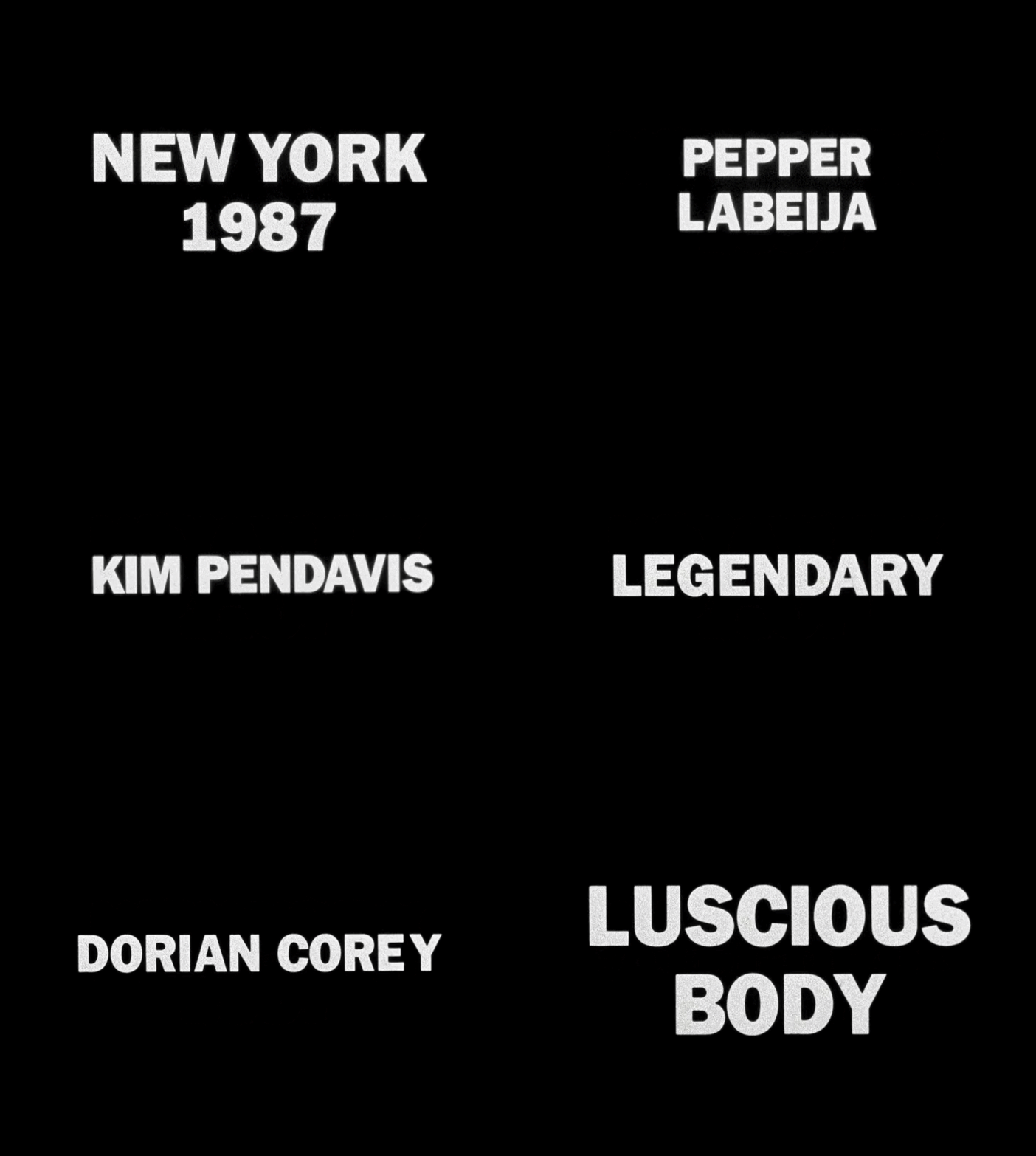
Paris Is Burning, 1991, directed by Jennie Livingston
Tuesday, November 10, 6 pm, Lincoln Center, Visual Arts Complex, RM SL24L
Panelists: Associate Professor of Anthropology and the Co-Program Director of Urban Studies, Aseel Sawalha, and Clinical Professor of Visual Art, Joseph Lawton, moderated by Stephan Apicella-Hitchcock, Associate Dean for Undergraduate Education, Arts & Sciences
Open to all. With pizza and prizes.
Directed by Jennie Livingston, Paris Is Burning is a seminal documentary that chronicles the vibrant ball culture of New York City in the late 1980s. The film celebrates the joy and sense of family within Black and Latino LGBTQ+ communities, capturing drag balls as extraordinary spaces of liberation, self-expression, and empowerment.
By highlighting ballroom subculture, voguing, and the house system, the film brought national attention to the creative and resilient support networks of queer and trans performers of color and established ballroom culture as a foundational influence on modern fashion, dance, and pop culture.
The documentary also addresses issues of racism, poverty, and the 1980s HIV/AIDS crisis, and sparked important debates surrounding self-determination and representation. Ultimately, Paris Is Burning, in all its complexity, honors the legacy, strength, and pride of its icons.
About the 2026-2027 Film Series:
This season, Films Worth Talking About, Even If Difficult, has expanded its programming into a broader interpretive territory. “Difficult Films” are not limited to movies that are emotionally challenging or politically provocative; they can also refer to visually experimental, sonically demanding, historically complex, or temporally shifting films. Ultimately, the series is a pretext for gathering, watching films, eating, and talking—a communal exercise in which we discuss, discover, and sometimes disagree—all of which are part of the experience.
The Office of the Arts & Sciences Dean invites you to step outside your regular streaming queue, experience something different, and join a community of curious film lovers. The series alternates between campuses twice per semester, so please bring your friends, an open mind, and have a question ready. We also offer raffle items connected to the film. By participating, you could walk away with a special prize AND a different perspective.
The Fordham University Galleries Ildiko Butler Gallery June 5 – August 23, 2026 Fordham University at Lincoln Center map 113 West 60th Street at Columbus Avenue New York, NY 10023 fordhamuniversitygalleries
I prefer to avoid claiming any profound meaning to be found in the images I create. These paintings are simply meant to be looked at, and it is hoped that they communicate in a purely visual language, not needing a narrative explanation. Either the work captures a viewer’s imagination or it doesn’t. Frankly, unfortunately, some of that ‘art critique stuff’ can be rather pretentious.
However, I do believe creative acts represent attempts to validate self-worth, or a means of documenting one’s existence, announcing that, for a short time, “I was a part of humanity.” So, these paintings are reflections of my imagination, starting usually as doodles, then turning into temporary obsessions. That said, it would be disingenuous not to admit that I am inspired by the works of other artists, often resulting from a ‘throw-back’ to works seen in museums, galleries, books, then trying to prove to myself “I can do that.” A spark ignited by another artist is then transformed into something derived from my own alchemy of psychological history mixing subject matter, color, design, etc., into something a little different, made up of other’s ideas, but resulting in ‘art’ which I am uniquely responsible for.
This explains why these works seem to lack any central style or theme. I like the challenge of “differences” and not just in art. So, if this exhibit represents anything more than viewers getting lost in the visual language of art, and escaping into something perhaps personally “meaningful,” let it applaud the theme of diversity – an openness to recombining concepts and how we think, transforming old ideas into something a little different, which inherently requires and welcomes sharing, a process which often brings about something positive and worthwhile because it emanates from a collective inspiration. I am happy to share this work, a small contribution, created during my time of ‘being a part of humanity.’
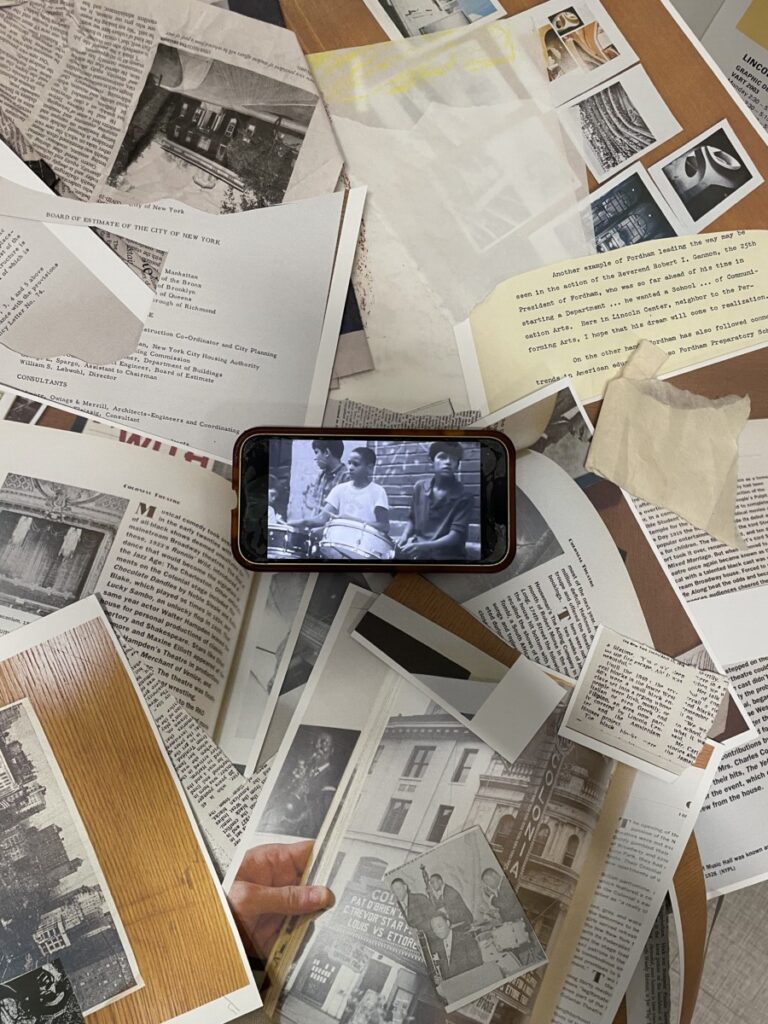
In VART 2222 Art of the Interview, students record interviews with community members who discuss the past, present and future of the Lincoln Square neighborhood, which was demolished in the 1950’s to build Lincoln Center for the Performing Arts, Fordham College at Lincoln Center, and other developments.
This Fall 2025 class was generously supported by funding and staff at Fordham’s Center for Community Engaged Learning
On Wednesday December 17th, the Fall 2025 class presented videos highlighting various stories at Good Shepherd Faith Presbyterian Church, where many interviewees are members:
This short film by Nora Kinney features interviews with Freddie Richardson, Humberto Pichardo, Jackie Brown Richardson and Tanisha Hill
Good Shepherd-Faith Presbyterian Church, by the way, is the last standing church to predate the Lincoln Center urban renewal project that demolished the rest of the neighborhood, and has a rich civil rights history.
Video by Ayden Suber, featuring a story told by Huberto Pichardo
Lauren Vaughn and Kylie O’Toole made this video from an interview with longtime Lincoln Square community member, Mr. Freddie Richardson
Phillip (Rohde) Costello created this piece from interviews with Freddie Richardson and Humberto Pichardo.
Here is Amanda video featuring stories told by Freddie Richardson and Tanisha L. Hill.
Sage Rochetti’s video features stories by Freddie Richardson and Tanisha L. Hill.
Certain abstract paintings live as maps towards our interior labyrinth. Through their silent direction we might arrive into our deepest accommodations.
Not far from our front door on 60th Street towards the Hudson River was a hill which led to a tunnel. We would enter through a hole in the metal fence. Passing trains rolled by. People lived there. Each visit was mysterious.
On one occasion a man walking on the train tracks stopped and spoke with me as he was headed deeper into the tunnel. His eyes were experienced. The conversation was brief. I am grateful for his words.
Moments of surprise ferry oxygen to my internal incandescent candle. These paintings are some of its light. — Mason Saltarrelli
Mason Saltarrelli navigates a bridge between beings and spirit by engaging with a succinct collection of discovered and abstracted characters and syllabaries. Painting and drawing intuitively—his expressiveness articulates continuing, woven motifs which invite unlimited exploration from the watcher. Saltarrelli’s jubilant work transforms human, animal and inanimate beings into buoyant embracing remembrances in an ever-evolving carousel of shape and color.
Mason Saltarrelli (b.1979, New Orleans, LA) graduated from Fordham College Lincoln Center with a B.A. in Photojournalism in 2001. His work has been shown at Turn Gallery, NYC, Timothy Hawkinson Gallery, Los Angeles, Ca, The Mass, Japan, Meessen De Clercq, Belgium, Guild Hall, East Hampton, Ace Hotel, New Orleans, Marvin Gardens, NYC, Galleri Jacob Bjorn, Denmark, Shrine Gallery, NYC, and Gallery 9, Australia among many others.
In a garden, I kick at a cobblestone path. I ignore the other children and move toward my favorite plant. My licking leaf tree. I pull one of the leaves away and raise it to my mouth like a question. I turn it over, feeling the hairy side with my thumb as I run my tongue over the back of the leaf until it is floppy and creased, relishing the magic of sensation, absorbing fascination through my mouth and fingertips. Having always explored my world sensorially, I build spaces of color, light and material through multilayered painted and collaged surfaces.
The nature of things is more or less based on a binary. In my work I explore the inseparable combination of anxiety and joy I feel while anticipating the nature of things oscillating between two points, visualizing a way that binary space can be punctured and trespassed. Paint becomes an object when I cut from the cloth or page allowing me to try endless placements. Working symmetrically means each mark becomes conversational, and the subject or figure can rest behind the static. All of the swatches affixed to my paintings and installations bring the body and mind into question as structures of bondage. I imagine the compulsively wrapped and strapped edges of my paintings as corporeal and contemplative armatures that hold spectral displays inside, visions of transcendence, clarity through chroma. JAW
Artist Bio
Born, 1990 in Cincinnati, Ohio, United States
Jack Arthur Wood Jr. is a visual artist, writer, curator and educator based in Ridgewood, Queens. Wood studied at Guilford College, in Greensboro, NC, receiving a BA in printmaking in 2012, and earned an MFA in printmaking from Texas A&M University — Corpus Christi in 2017. Wood received a New York Foundation for the Arts Fellowship in painting in 2024. He has been a resident at The Skowhegan School of Painting & Sculpture, The Wassaic Project, The Jentel Foundation, Little Bear Hill, and Tiger Lily Press. Wood has had solo / two-person presentations at Rachel Uffner Gallery, New York, NY; My Pet Ram, New York, NY; Conduit Gallery, Ridgewood, NY; His work has been exhibited at Chozick Family Gallery, New York, NY; Chart, New York, NY; Geary Contemporary, Millerton, NY; The Wassaic Project, Wassaic, NY; Soloway Gallery, Brooklyn, NY; 5-50 Gallery, Queens, NY; Field of Play Gallery, Brooklyn, NY; Ortega Y Gasset Projects, Brooklyn, NY; No Place Gallery, Columbus, OH; Heaven Gallery, Chicago,IL. He currently teaches at Montclair State University, in New Jersey.
Ground Meets Water: Photographs by Michael Chovan-Dalton ?>
The Fordham University Galleries Ildiko Butler Gallery June 9 – September 7, 2025 Fordham University at Lincoln Center map 113 West 60th Street at Columbus Avenue New York, NY 10023 fordhamuniversitygalleries
In 1993 I moved to Hoboken, New Jersey and began to explore what this latest version of home was going to mean to me. After travelling along different NJ Transit rail lines, and wandering around different train stations, I found myself being drawn to ponds, reservoirs, and rivers that had become fishing holes for families. The spiritual and adventurous interactions between parents and children, along with the feeling that a tradition or an important skill was being passed along, was fascinating and beautiful to me.
I call this work Ground Meets Water because I always felt that there was a coming together at these fishing holes, a kind of “levelling of the playing field” with me and with others. People were generous with their time, their food, and their conversation and I am grateful for that. — Michael Chovan-Dalton
Michael Chovan-Dalton is a photographer and Professor of Photography at Mercer County College in New Jersey and the Director of the JKC Gallery in Trenton NJ. He is the producer of PhotoWork with Sasha Wolf and the host of Real Photo Show podcasts. He is also a founding member and curator of the Homecoming Biennial at RIT and the media partner for the Chico Portfolio Review in Montana. His work is in the collections of SF MOMA and The Fred Jones Jr. Museum of Art at the University of Oklahoma. Chovan-Dalton received his BFA from the School of Visual Arts and his MFA from Columbia University.
Tony Nominated Broadway producer, entrepreneur, writer, director, and performer, Marjuan Canady (FCLC ’08), returned to campus on April 1st to discuss with “Arts, Social Justice, & Human Rights” students (taught by Fadi Skeiker) concepts in applied theater and the importance of forging one’s own path when navigating a career in the arts.
After graduating from Fordham with a degree in theatre and African and African American studies, Canady continued her studies at NYU Tisch which led to the production of her one-woman play “Girls! Girl? Girls.” Using this experience as a framework, Canady explained to students how they might use a grassroots approach to theater and production, and how to use theater to engage with topics that are meaningful to them. Canady also challenged students to consider the use of satire when tackling larger, societal issues. She presented them with several approaches to satire and explained the concepts using examples from her own production of “Girls! Girls? Girls.” to show how these techniques could be applied in their own work.
During this workshop, students were tasked with a solo theater exercise, in which they were instucted to identify an issue that they are passionate about and then create a monologue or scene using satire. Students explored three techniques of satire – exagerration, reversal, and parody – and were instructed to encorporate two of them into their monologue or scene. Through this exercise students where able to apprciate the power of satire and comedy when addressing potentially serious issues. By creating room for humor in the discussion, satire allows audiences to step back and address the “ridiculousness” of current societal issues. Through Canady’s teachings, students learned how to use applied theater to take deep issues that are often difficult to discuss, and to create a natural and intimate dialogue around these issues through performance.